HILL COUNTY JOURNAL / Land
More room. Clearer plans.
Buying land in Hill County: the questions to answer first
Read the guide ↓THE SHORT ANSWER
Acreage is useful only if the parcel can support your intended use. Before buying rural land, verify legal access, restrictions, water, wastewater, electricity, flood considerations, and the approvals your plan requires. Get written answers tied to the parcel rather than assuming nearby development proves feasibility.
Describe what you want to do
“A few acres” is a size preference, not a development plan. Start with a plain description: a primary home, a workshop, animals, a business activity, or land you intend to hold. Include the number of structures and the sequence in which you would build them. Those details help an agent identify which questions need early answers.
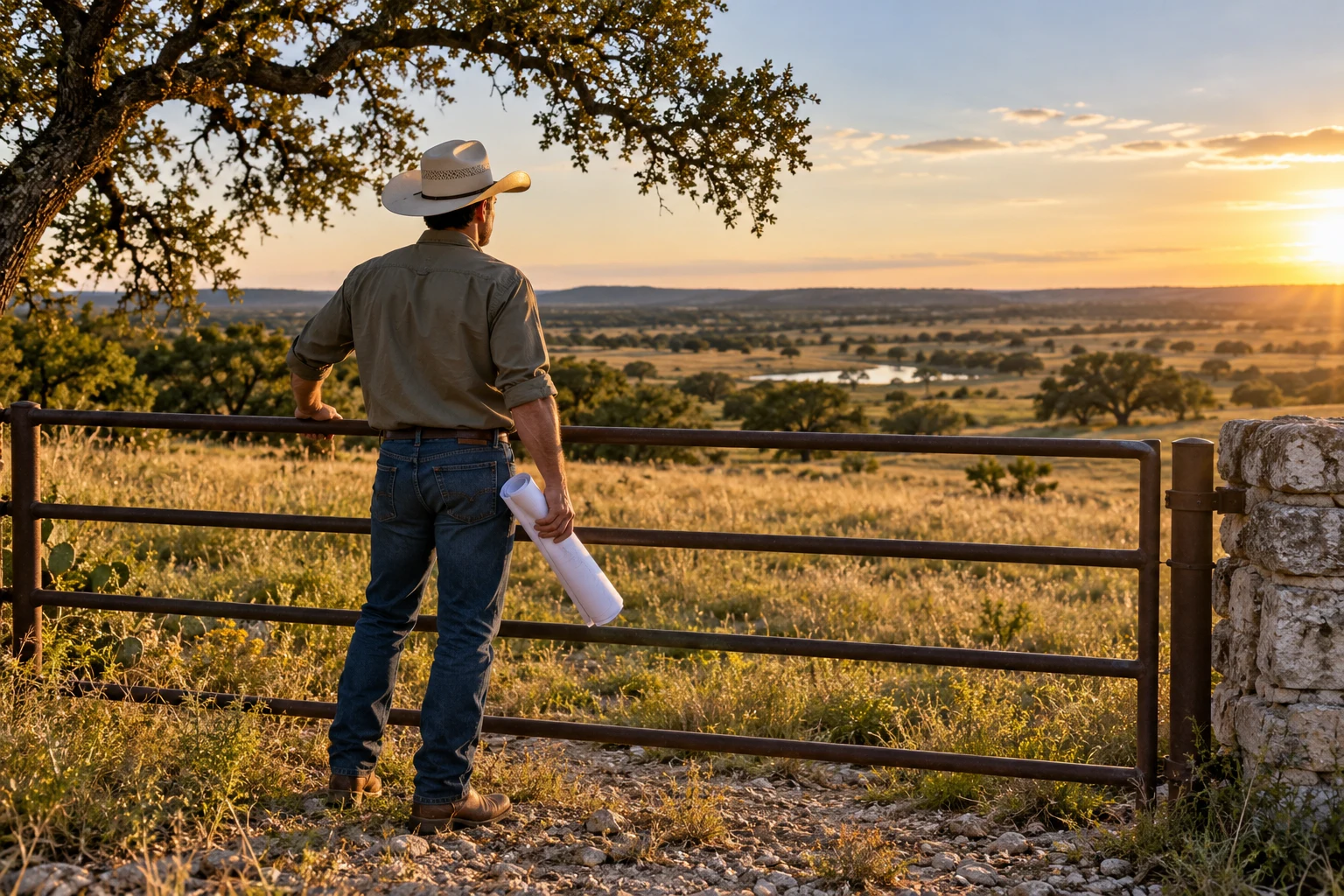
Put the proposed homesite, driveway, utility route, and other uses on a rough sketch. It does not replace an engineered design, but it helps reveal conflicts before they become expensive surprises. A long driveway, a difficult utility extension, or limited space for wastewater infrastructure can change the economics of an otherwise appealing parcel.
Separate access from appearance
A visible road is not the same as a verified legal right to use it. Ask the title company and appropriate professionals to review access documents, easements, and restrictions. Confirm who maintains the road and what responsibilities a buyer would take on. If access depends on another parcel, resolve that detail before relying on it.
Next, contact the relevant service providers with the exact location. Ask whether water and electric service are actually available, what work would be required, and what the provider can put in writing. A nearby line or meter is a reason to investigate, not a connection guarantee. For a well or septic system, involve the relevant district, county office, and licensed professionals early.
Turn uncertainty into a feasibility file
Hill County publishes subdivision rules and maintains an on-site sewage facility permitting resource. Whether a particular division or development is allowed depends on the actual parcel and plan. Ask the responsible office which rules apply; do not substitute a seller’s description of “unrestricted” for a review of public requirements and recorded documents.
Build a small file with the survey, title materials, service estimates, proposed layout, and written agency responses. Mark every answer as confirmed, estimated, or unresolved. Then review the cost and timing with your agent before committing. Attractive land can still be the wrong purchase if making it usable exceeds your budget. The strongest decision connects the open-space dream to a realistic path for carrying it out.
Your next steps.
- Define the intended use and proposed structures.
- Verify legal access and recorded restrictions.
- Request water and electric availability in writing.
- Review septic, well, subdivision, and flood requirements before committing.
Go to the source.
Sources checked October 20, 2026. Follow the linked source for current requirements.
- Hill County: OSSF permits and development contacts
- Hill County: 2025 subdivision rules
- Prairielands GCD: well forms
Research-assisted editorial guidance, not property-specific legal, tax, financial, or engineering advice. How we research and update the journal.